Story by Elmarie Smit
Images supplied by Grain SA
NAMPO Harvest Day 2026 delivered record exhibitor participation and a record-breaking Wednesday attendance despite mounting pressure on South African agriculture from rising production costs, disease-control measures and volatile global markets.
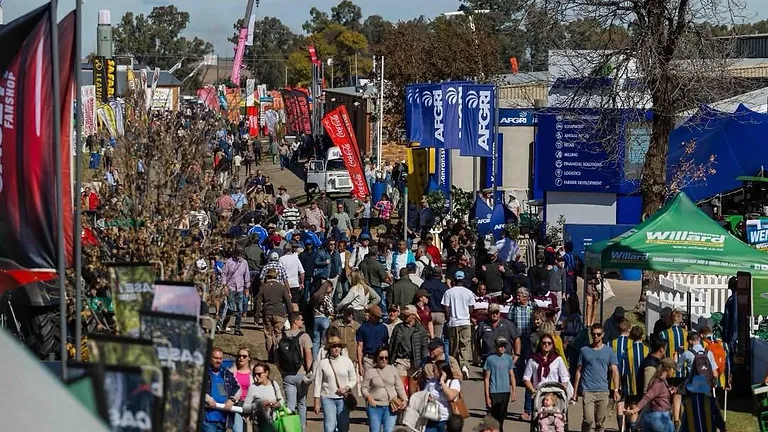
This year’s event at NAMPO Park near Bothaville hosted a record 910 exhibitors, up from 900 in 2025 and 865 in 2024.
Wednesday also set a new single-day attendance record of 24 579 visitors, contributing to a total attendance of 81 822 for the week. Air traffic into the showgrounds remained strong, with 311 aircraft and 100 helicopters recorded during the event.
The records were achieved despite one of the most difficult operating environments the sector has faced in recent years.
The event unfolded against the backdrop of ongoing foot-and-mouth disease (FMD) challenges in South Africa, which resulted in no cloven-hoofed livestock being exhibited at this year’s show.
At the same time, Grain SA used the platform throughout the week to highlight growing financial pressure on producers, including rising input costs, financing strain, logistics bottlenecks and uncertainty around global trade conditions.
Opening day discussions focused heavily on profitability and long-term farming sustainability. Grain SA chairperson Richard Krige warned that rising input costs, tightening margins and market volatility were placing increasing pressure on farming viability and broader food security.
“We cannot separate sustainability from profitability,” said Krige during a panel discussion titled To Farm or Not to Farm: The Economic Reality. “If producers are not profitable, investment slows, succession becomes uncertain, and food security is placed at risk.”
Grain SA CEO Tobias Doyer said South African agriculture would increasingly need to position itself as a globally competitive, export-driven industry supported by productivity gains, improved logistics and stronger market systems.
Financing pressure also emerged as a dominant theme during the week.
Grain SA held engagements with agricultural banks, government and National Treasury around rising debt burdens and the impact of escalating production costs on producer sustainability.
According to the organisation, fertiliser and fuel now account for approximately 45% of production costs in many grain farming operations, while fertiliser prices have in some cases increased by as much as 80%.
Trade policy uncertainty also featured prominently, with Grain SA warning that prolonged delays in finalising wheat tariff decisions were leaving local producers exposed to subsidised international competition and increasingly volatile global grain markets.
Beyond commercial farming concerns, NAMPO 2026 also focused strongly on farmer development and agricultural transformation.
Phahama Grain Phakama (PGP), Grain SA’s farmer development division, hosted discussions around land ownership, title deeds, financing reform and commercialisation support for developing farmers.
Agriculture Minister John Steenhuisen told delegates that successful farmers operating on state land should increasingly receive title deeds to unlock access to finance.
“Where farmers are successfully farming on state land, we should be giving those title deeds over to those farmers. They have earned their stripes,” Steenhuisen said.
Infrastructure and logistics constraints remained recurring concerns throughout the week, with stakeholders highlighting deteriorating rural roads, storage limitations, export bottlenecks and port inefficiencies as major constraints affecting producer profitability and competitiveness.

Nampo 2026 from the air